
Where does collective intelligence begin?

The meeting had already gone on for two hours.
Agenda items were slipping, tensions were rising, and the room had slowly shifted from collaboration to escalation. At some point, someone said what pops up in many organizations in this kind of situation:
We need to activate collective intelligence!
As if collective intelligence were an emergency resource stored behind glass, ready to be used exactly when pressure becomes unbearable.

The truth is that collective intelligence rarely appears in moments of urgency unless it has been cultivated over time.
Far from being an emergency response mechanism, collective intelligence is the long-term consequence of the quality of interactions within an organisation

Collective dumbness
Collective intelligence grows slowly, often invisibly, in the spaces organisations usually consider “non-essential”: conversations without immediate deliverables, moments of reflection without urgency, and occasions for people to think together before they are forced to solve something together.
These spaces matter because they allow people to build a shared language. They create the conditions for weak signals to be noticed, interpreted, and connected before they solidify into crises.
Without them, organisations gradually lose their capacity to sense, and what could have been understood early finds no place to land; misunderstandings accumulate silently, tensions sediment beneath operational routines, and signals travel through the organisation unnoticed until they eventually arrive at the table already transformed into “problems to be managed.”
And when this happens, another absence becomes visible, the absence of the very condition that makes collective intelligence possible in the first place: the willingness to expose oneself, to think together, and to remain in uncertainty long enough for shared understanding to emerge before rushing toward solutions.
Without this willingness to think together, being together gradually becomes associated only with pressure, meetings turn into spaces of escalation, urgency, difficult decisions, and defensive positioning.
Collaboration stops being generative and becomes emotionally costly.
Over time, something subtler — and more dangerous — begins to happen: people start protecting themselves not only from the problems, but from the experience of being together itself.
That is one of the deepest organizational risks of all.
And this challenge feels particularly relevant today.

Highly connected, weakly relational
Many organisations today are highly connected but weakly relational.
They have optimized coordination while slowly losing the capacity for collective sense-making.
Calendars are full, communication channels are constantly active, and meetings occupy an increasing portion of organisational life — yet genuine spaces for shared reflection are becoming rare
In many workplaces, collaboration has become performative: people align quickly, react continuously, update constantly, but rarely have the opportunity to pause, interpret, and understand what is actually happening — let alone do so together.
Acceleration creates responsiveness, but not necessarily understanding.
Under continuous pressure, organisations risk losing their ability to sense.
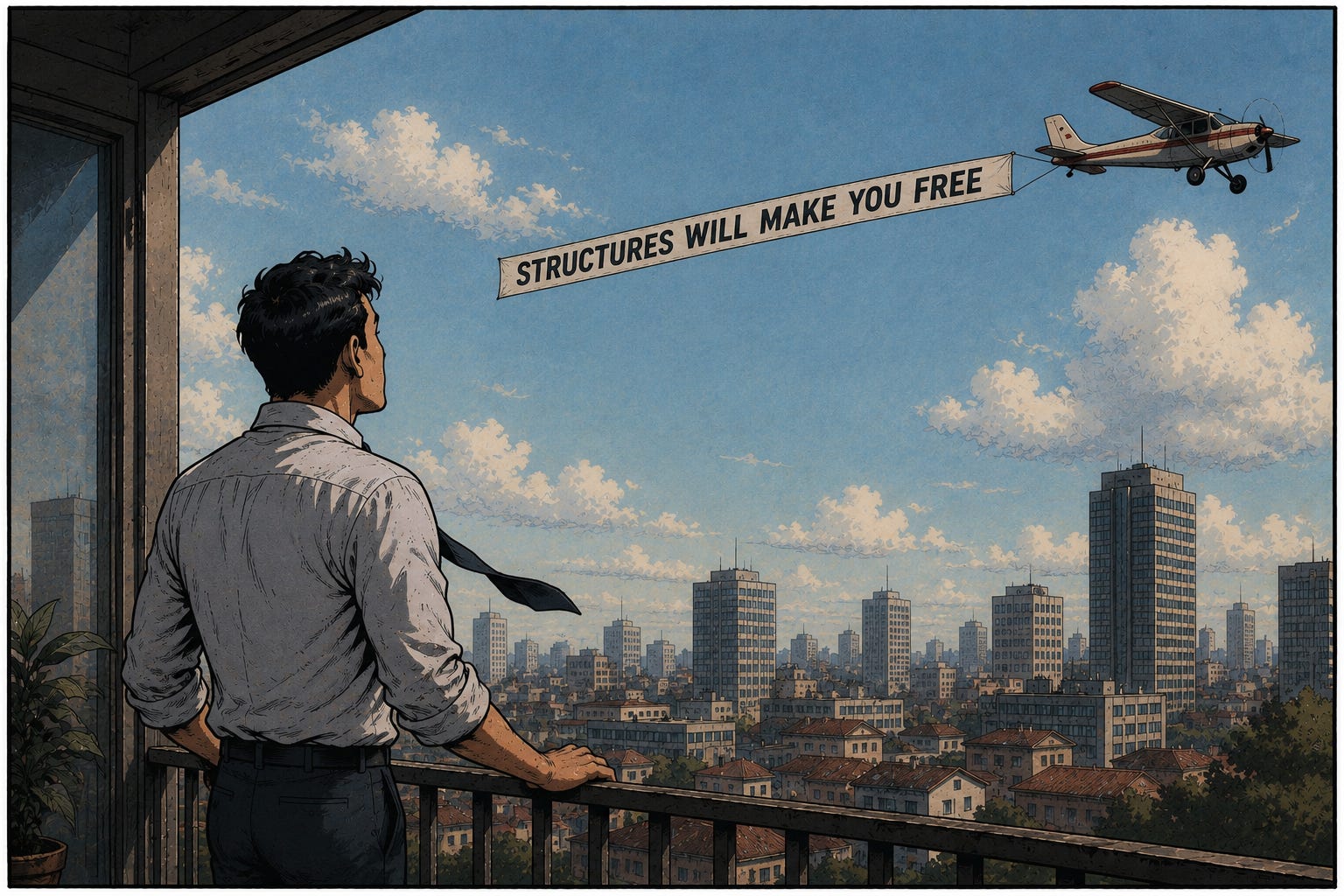
Structures will make you free
Collective intelligence takes shape in the everyday interactions through which people learn — or fail to learn — how to be together.
Most organisations carefully design systems of coordination. Far fewer intentionally cultivate the interactions through which collective intelligence can emerge
If collective intelligence emerges from the quality of interactions, then a practical question follows: how might organisations intentionally cultivate those interactions?
The answer lies not in good intentions, but in those patterns of interaction that make participation easier, perspectives more visible, and shared understanding more likely.
An interaction pattern is a recurring way in which people engage with one another. It shapes who participates, who remains silent, how attention is distributed, how decisions are made, and how meaning is created collectively.
This is where Liberating Structures become particularly relevant.
Originally developed by Henri Lipmanowicz and Keith McCandless, Liberating Structures are a repertoire of simple interaction patterns designed to distribute participation, include multiple perspectives, and make collaborative thinking more accessible.
What shapes organisational life is often less the formal structure of the organisation than these recurring ways of relating, listening, deciding, navigating tensions, and making sense together.
By gently reshaping the conditions of interaction, Liberating Structures make participation easier, attention more distributed, and shared understanding more likely to emerge.
I began working with Liberating Structures in 2018, and since then I have contributed to their diffusion by applying them within client organisations, teaching their principles, designing workshops, trainings, and learning experiences across a wide range of contexts, and organizing meetups across Italy.
From my perspective, their deeper value lies not in solving problems together more efficiently, but in creating the conditions for people to rediscover how to think together.
And perhaps that is where collective intelligence actually begins. Not in moments of urgency. Not when complexity becomes overwhelming, but in the everyday interactions through which people learn — or fail to learn — how to listen, make sense, and stay in uncertainty together.
Maybe the real question is not how to activate collective intelligence during emergencies.
Maybe the real question is:
What are we building together to avoid finding ourselves, once again, standing in front of that glass?
If you’re interested in cultivating collective intelligence within your organisation, I’d be happy to explore it together. Feel free to get in touch.
And if you’d like to dive deeper into Liberating Structures, Keith McCandless and Nancy White have just published a new book — Liberating Structures Fieldbook —this week. You can find it here.
Together with the help of S. Fisher Qua, Anna Kathleen Jackson, and Ann Blocker they have also launched a completely redesigned website.